Pages

Pages

Monday, 30 January 2012

Spain Declares War on Online Pirates


As 2012 began—and less than two months after winning control over the Spanish parliament—the right-leaning Partido Popular passed a controversial new anti-Internet-piracy law that will impose strict penalties on website owners who fail to remove copyrighted material from their sites. Sound familiar? The law, named after the former culture minister, Ángeles González‑Sinde [above], gives the Spanish government nearly the same broad-ranging authority found in the equally controversial Stop Online Piracy Act (SOPA) now wending its way through the U.S. Congress. Owners of the material can now complain to a government commission that can issue an order to block a website's service. The Spanish law was initially brought up for consideration and rejected in 2010. Evidence obtained by the Spanish paper El País suggests that the United States has been pushing hard for a reevaluation of the measure ever since, using trade agreements as leverage to prod the Spanish government to resurrect it. It's no surprise that the United States has shown such interest. Piracy is epidemic in Spain. Thirty percent of the population uses file-sharing sites, often to download Hollywood movies. But there are good reasons to think that the Sinde law will only encourage more of this behavior. Because the law goes after only the content provider and leaves intact an individual's right to a digital copy, it may actually encourage Spanish citizens to use peer-to-peer file sharing, says Rosa María Garcia Sanz, a professor in the department of communication law at the Complutense University of Madrid. In fact, there is little evidence to suggest that the enforcement strategies called for by the new law actually work to stop illegal downloading. France passed a law in 2009, known as Hadopi, or the "three strikes" law. It gives the government the authority to interrupt service for individuals who are caught downloading illegal content after they've received two warnings. Plenty of people took the legislation more as a challenge than a threat; many immediately began avoiding detection, thereby sidestepping the regulation, with the aid of virtual private network servers. The Sinde law will be just as tough to enforce, according to Professor Sanz: "Even blocking domain name system [DNS] sites," she says, "would just encourage users to use alternative and unregulated DNS servers. In other words, there is a real problem of applying the law because it [is] so easy to circumvent the technical barriers used to block users from reaching the websites." The same will likely be true in the United States, where SOPA has been held up in the House Judiciary Committee since last year, and a far-flung group of individuals and organizations have targeted companies that have come out in support of the antipiracy measure. Even the Obama administration has suddenly taken an under-the radar position against SOPA. Developers are already providing tools to circumvent the legislation. The Firefox add-on DeSopa was written as a proof of concept, but if the law is implemented, the add-on would allow users to resolve blocked domains by obtaining an IP address through foreign DNS servers. But these kinds of solutions, which would certainly become popular if SOPA is enacted, carry serious security concerns. They would most likely increase the incidence of DNS hijacking, whereby an attacker redirects queries to a faulty, and potentially malicious, IP address. Security analysts at Sandia National Laboratories, in Albuquerque, raised these concerns in response to both the Senate and House versions of the bill, calling the DNS filtering mandate a fruitless " 'whack-a‑mole' approach that would only encourage users and offending websites to resort to low-cost work-arounds." It's unclear how seriously members of Congress are taking this advice. Indeed, the Obama administration's opposition may make SOPA moot. As U.S. lawmakers pause to catch their breaths after the first rounds of this battle, they might consider taking an even bigger step back to watch how the Spanish effort plays out—to see whether legislation actually brings about the hoped-for result.
How clothes retailer Peacocks ran up £750m debts


The retailer Peacocks is the biggest company in Wales to have collapsed in recent years. There are not many firms with a headquarters in Wales with a turnover of more than £700m. A number of reasons have been cited for the failure, including the role of the Royal Bank of Scotland (RBS) during talks to restructure its debts. But the reality is that Peacocks was brought down by the deal that allowed a management buyout in 2006. The context is important here, in 2005 Peacocks was a plc and expanding strongly. A few years earlier it had bought the Yorkshire-based retailer Bonmarche, which had 350 outlets. There were already 418 Peacocks stores at the time. But the chief executive Richard Kirk felt it was not being taken seriously enough by investors in London and he led a management buy-out so the firm could expand at a faster rate. In order to do it, the company borrowed £460m. Heavily criticised The last official company accounts we have date from 2010, and they show that by then the company's overall borrowings had risen to £596m. The administrators KPMG now say the overall debt stands at £750m. That debt is around the same as the overall sales of the group. It means that every pound being taken at the tills is ultimately owed to someone else. The debts became too much for Peacocks which went into administration last week after talks on restructuring part of the debt collapsed. Administrators KPMG say the overall debt stands at £750m The taxpayer-owned RBS was one of the lenders which refused to pump any more cash into the business. Despite being heavily criticised by some local MPs and many of the staff, RBS insists it was not alone in refusing to invest any more. The reason Peacocks' debt rose so much was because of part of its borrowings called Payment in Kind or Pik notes. These have high interest rates, in this case 17% charged on a compound basis, but the interest is deferred and rolled over for repayment later on. When the times are good, they allow companies to grow quickly by putting off repayment. But eventually they have to be dealt with. At the time of the management buyout in 2006, Peacocks owed £150m pounds in Pik notes. In 2010, that debt had risen to £300m. 'Mountain of debt' Before the company went into administration, those Pik notes were said to be worth close to £400m. In a business selling relatively cheap clothing where there are tight profit margins, the banks could not see a way where Peacocks could get close to paying off this debt. In defence of Peacocks' directors, the management buy-out which saddled the company with so much debt was a deal done at the height of the buy-out boom when many similar deals were being signed off. The model works if the company is sold off after a few years at a higher price but in this case the credit crunch and the recession made that difficult. Sadly, it shows that in recent years, the success of one of Wales' most high profile and biggest companies was built on a mountain of ever-increasing debt.

UBS trader denies gambling £1.5 billion in Britain's biggest banking fraud


Mr Adoboli, 31, east London, will go on trial accused of losing the cash while working for Swiss banking giant UBS. He spoke only to enter not guilty pleas to two counts of fraud and two counts of false accounting as he appeared in the dock at Southwark Crown Court. Adoboli, wearing a tailored grey suit and dark blue tie, sat forward in his seat and took notes as pre-trial arrangements were made. He said "Thank you, your honour" as Judge Alistair McCreath set a provisional trial date of September 3. "I remand you in custody," the judge told Adoboli. "I or some other judge will hear some application for bail."

Sunday, 29 January 2012

In Spain, taxmen snoop about homes rented to sun-seeking vacationers — then visit the owners who neglected to report the income


In Greece, tax officials fly helicopters over residential areas to spot swimming pools of the alleged poor. In Italy, inspectors raid elite ski resorts to catch the down-and-out in their Ferraris. In Spain, taxmen snoop about homes rented to sun-seeking vacationers — then visit the owners who neglected to report the income. File photo by Virginia Mayo, AP The European Union, whose headquarters are pictured here, has been concerned about the debt crisis in southern Europe. EU officials blame part of the economic mess on a culture of tax evasion.EU officials blame part of the economic mess on a culture of tax evasion. Ads by Google CPD Online, On Time Online CPD - for when your deadline is demanding.  Evading taxes is almost a national pastime in European nations such as Greece, Spain and Italy, and for years their governments largely looked the other way. On Monday, the 27 nations of the EU will meet in Brussels to focus on how to boost growth and jobs. But as the southern European nations struggle with a debt crisis that threatens to overwhelm the European Union, their recently installed governments feel they must become more like their more solvent northern neighbors, where the crime of tax evasion is taken seriously. Greece, Spain, Italy, Portugal and other countries are raising taxes and clamping down on those who have found creative ways not to pay them. Many people admit they cheat, but the wealthy say they are being unfairly singled out to cover for government overspending — and people in the middle class, who have seen their household incomes crumble, are bitter about losing even more to taxes. "In this country, (most of us) are struggling day-to-day in order to make ends meet," said Argiris Eleftheriou, 76, of Athens. "The pensioners and the employed are the only ones that aren't evading taxes. We're paying the taxes of the rich, too." EU officials blame part of the economic mess on a culture of tax evasion in debtor nations that has cost billions in revenue that could be used to shore up their finances. Greece has a projected debt burden of 162% of GDP this year. The amount of taxes past due to the state is $78 billion, according to a 2011 report by the EU's Task Force for Greece. EU officials say that about half of that will never get collected, and the other half is tied up in 165,000 pending court cases. Paying for things in cash is the norm in Greece (and Italy and Spain), making it hard for tax inspectors to track. In Greece, cash transactions accounted for 25% of GDP, according to a 2011 report by Friedrich Schneider, a professor of economics at the University of Linz in Austria. And the EU believes tens of millions of dollars in Greek income has been deposited out of sight in Switzerland banks. Greece is pushing back with a "naming and shaming" campaign. This week, the Greek Economics Ministry published the names of 4,151 individuals who owe a total of more than $19 billion in taxes including a famous singer, a professional basketball player and a former newspaper publisher. "Our sovereignty is being chipped away because some are not paying their taxes," said Finance Minister Evangelos Venizelos, referring to the strict fiscal oversight imposed by the EU and IMF in return for bailout funds. Meanwhile, new taxes keep coming. In the past two years Greeks have seen a self-employment tax of $390 to $650, a solidarity tax of about 1% to 5% of income and a property tax. More are expected, but locals say they can't pay. "Life has drastically changed; we don't go out anymore; we're locked in our homes and close to depression," said Eleni Benekou, 48, a middle-class housewife in Athens. "(Recently) I went to the flea market to buy some things, but I didn't dare open my wallet." In Italy, the focus is on tax evasion by the super-rich, which ran rampant under the leadership of former prime minister Silvio Berlusconi— also accused of tax dodging and who once famously said that evasion of high taxes was a God-given "right." Berlusconi successor, technocrat Mario Monti, has vowed to get Italy's house in order by reducing spending and increasing tax revenue. One of his first actions has been to clamp down on "the pretend poor," as Italian media have dubbed the super-rich tax evaders. While one in four Italians — 15 million — reported no taxable income last year. Italy says that at least 3 million of those own at least three homes. Meanwhile, Italian taxpayers reporting incomes of less than $26,000 owned 188,000 Ferraris and Lamborghinis, more than 500 private airplanes and about 42,000 yachts. Monti has ordered tax police to go to the super-rich wherever they are. In raids on the elite Italian Alps ski resort of Cortina in early January, officials found 42 high-end sports cars belonging to owners who reported less than $26,000 of income annually. The Italian government is also cracking down on money-laundering, lowering the maximum allowed for cash transactions to from $3,200 to $1,275 and putting dogs at the Swiss border to sniff out large sums of cash. (It is common for Italians to drive their money over the Alps to Swiss banks, tax agents say.) So far, Italian officials say this has netted $52,300 on average per day at the border, up from almost zero a year ago. Since Monti took office in November, Italian tax police have identified $65 billion in untaxed money, officials announced Wednesday. Monti is also pushing for a new tax bracket for the super-rich and a financial transaction tax. Even TV commercials appeal to Italians to help find these "parasites of society." And while Italians hang effigies of tax officials at protests, some agree with the push. "Everybody has to do their part, but the rich should do more than their part," said Angela Perin, 56, a school administrator in Rome. "They've had it easy too long, and now everybody is suffering because of that." In Spain, officials also declared "an open season" on tax evasion. They have capped cash transactions at $1,300 and are cracking down on tax havens. Spain has taken hundreds of tax evaders to court, and tax police have caught about 200,000 individuals who had not declared income from rental properties — a large source of income in the sunny tourist destination — and an easy source of under-the-table cash, officials said. One of the first actions of Conservative Prime Minister Mariano Rajoy upon taking office in mid-December was to break a main campaign promise by raising taxes: The government has passed measures to raise income and property taxes by more than $7.64 billion a year and has added a new tax bracket for the rich — which increased the cap by 7% to a maximum of 56% in some Spanish federal states for those earning more than $390,000 annually. Some say the zeal for taxes as the solution to a country mired in debt and high unemployment of 21.5% will backfire. "The tax hike is going to have a perverse effect on the Spanish economy," said Miguel Borra, president of CSI-F, the main civil servant union in Spain. "That will include a growing lack of trust among the population (in government) as well as diminishing purchasing power." In crisis-hit but tax-averse Ireland, officials haven't raised income tax but rates on many other things have risen: taxes on pension contributions, property, carbon dioxide emissions and a hated "universal social charge," along with hikes in sales taxes. "They get called stealth taxes, but they're not particularly stealthy as we can see them coming," said Gerard Casey, professor of philosophy at University College Dublin. "They do it so they can say with a relatively straight face, smirking perhaps, 'We've not raised taxes.' " Emeline Callan, who runs a barbershop in Celbridge, County Kildare, says she earns less than minimum wage despite working nine or 10 hours a day — and the cost of her commute has doubled with the gasoline and car tax increases. Her frustration may be a warning to Europe's governing elites that they must find another way to balance the books. "The tax I pay gets me nothing that I need," she said. "The social charge is just a cover to gain more money from us to pay for the government's mistakes. It's loan repayment on a loan we the people didn't take out."

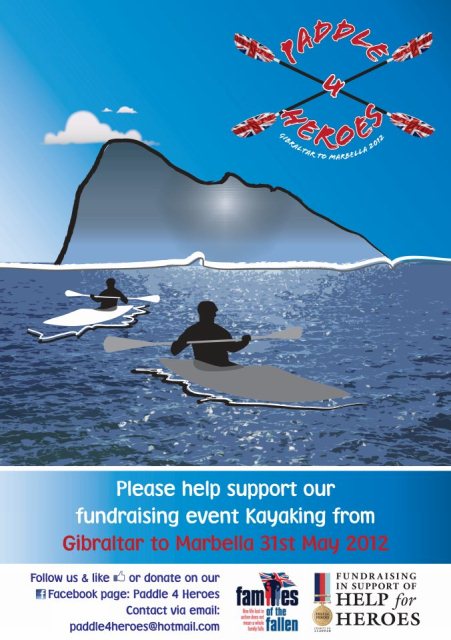
On the 31st May this year, nine men from Paddle4Heroes are going to paddle from Gibraltar to Marbella in Spain by kayak to raise funds for Help for Heroes and a new charity called Families of The Fallen.

Paddle4Heroes

PADDLE4HEROES, RAISING MONEY THROUGH KAYAKING - FOR HELP FOR HEROES AND FAMILIES OF THE FALLEN

On the 31st May this year, nine men from Paddle4Heroes are going to paddle from Gibraltar to Marbella in Spain by kayak to raise funds for Help for Heroes and a new charity called Families of The Fallen.  Both of these charities should touch the heart of anyone British, as they are at the forefront of helping servicemen and women recover from the trauma of war.

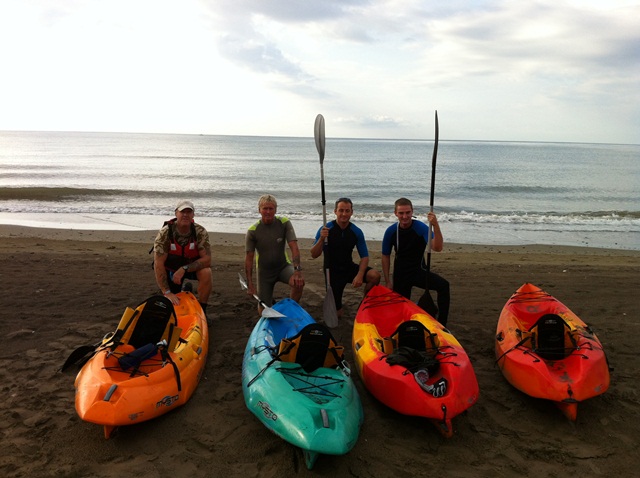
Of the nine paddlers (aged between 20 – 58!), six are ex-servicemen (including one from my own regiment) and all live on the Costa del Sol.  Several have experienced active service and all know the devastation that war can bring to everyone involved.

Indeed, the consequences of active service can be long lasting, not just for servicemen and women but also for their immediate families.  Both parties often need significant help readjusting to normal life (whether the trauma is psychological or physical) and that is where charities like Help for Heroes and Families of The Fallen come into their own.

Needless to say, Britain seems to have been continually at war for years now, with the Iraq wars and Afghanistan being notable.  However, our military forces also continually operate in many other areas including often as unsung UN peacekeepers, which can often involve significant risks – and injury.

Kayaking for charity

TRAINING, TRAINING AND...MORE TRAINING!

In fact, whilst deaths in battle always make the news, injuries rarely do and they, of course, far outnumber deaths, despite often being utterly life changing for those hurt.  Indeed, I hate to think how many British servicemen and women have sustained terrible injuries over the past twenty years – with their injuries never having made the news or having been ‘hidden’ deep within governmental statistics.   Certainly, many more servicemen and women (and their families) need help than most of us realise…

Needless to say, the point of the canoe trip by Paddle4Heroes from Gibraltar to Marbella (90 km) on the 31stMay is to raise funds for Help for Heroes and Families of the Fallen.  It is your money that keeps these charities going and your money that directly helps our servicemen and women in their time of greatest need.

So, please make an effort to spare some money for Paddle4Heroes.  What they are doing deserves your support and it would be great to think that any of you Britons, with any connection at all to Spain, could help to make the Paddle4Heroes event an outstanding fund raising success – that does justice to any Briton living or holidaying in Spain!

If you want to know more or wish to contribute to Paddle4Heroes then please see the Paddle4Heroes Facebook page.

Saturday, 28 January 2012

Prostitute in French footballer sex scandal launches own underwear range

The prostitute at the centre of the French footballer sex scandal has transformed from call girl to cover girl with a new underwear range. Zahia Dehar made headlines last year when she alleged that top France stars Franck Ribery, Karim Benzema and Sidney Govou had paid thousands of pounds for sex with her when she was just 17. Now 19, she has launched a new line of lingerie at Paris couture week with none other than designer Karl Lagerfeld shooting her lookbook. Advertisement >> Following the scandal, which ruined the reputations of the three stars involved, demand for Zahia soared and she became a lingerie model appearing on the covers of top fashion magazines. Now she has enlisted the help of top French designers including François Tamarin, Bruno Legeron, and Jean-Pierre Ollier to create the couture pieces for her collection. On her Twitter page, Zahia said that working with Lagerfeld had been a ‘dream come true’ while the designer was quoted as saying: “It was fun to do her.” He reportedly added: “She is very French courtesan, like Liane de Pougy or the Belle Otéro.” Ribery, 28, Benzema, 23, and Govou, 31, all faced three years in prison and fines of up to £40,000 for having underage sex. All three eventually escaped jail. Speaking after the scandal, the former prostitute said that Ribery, Benzema and Govou had all treated her “with utter respect” and should be left alone.

Protein Rich Diet Good For Losing Weight,


A recent research has revealed that a diet rich in proteins can prove helpful in making a woman to lose weight. The research was conducted by the researchers of the Sydney University. It has further been pointed out by the researchers that a change in the diet plan can lead to improved lifestyle. For the research, a number of women were recruited. The participants of the research were divided into two groups. The first group was provided with the rich carbohydrate diet plan and the other with rich protein diet. Moreover, the participants of the study were advised to meet their dietician regularly and were also asked to go for walk for at least 30 minutes a day. During the study, it was found that the women who relied heavily on a protein diet were successful in losing a significant level of body weight. The participants on protein diet reported of experiencing improved self esteem. Moreover, the iron level of the participants was also good as compared to the women relying upon carbohydrate diet. The researchers are of the view that their findings would bring a revolution in the way the women follow certain diet plans to lose weight. A large number of women are said to rely on carbohydrate diet for losing weight. A diet rich in protein can not only help a woman in losing weight but also helps in improving the immune system as the diet is rich in essential mineral, vitamins and nutrition which are essential for the over al growth of the body. These days, obesity has become a graver issue as many countries are struggling to deal with it. In the previous studies, the obesity has been linked with life threatening diseases like diabetes and heart diseases.

rich Irish still live life with a bang!


Not everybody is going broke in Ireland these days. While the bankruptcy courts continue to clog with casualties of the recession, like the Stokes brothers, there still remains a wealthy sector of society flying well above the financial carnage. Preferring to indulge in luxury jaunts outside the country rather than display any largesse at home, they head to places far beyond Irish shores for treasured moments they'll never boast about in the society columns. One such pair headed first class Down Under for a specially organised New Year's Eve treat for two, high atop the Sydney Opera House to view the biggest fireworks display on the planet. It was the ultimate night to remember for the middle-aged couple, and all organised by their personal concierge service -- where discretion comes as part of the package. Though the ranks of Ireland's rich and famous have been severely thinned out by the economic downturn, there are still plenty of low-profile millionaires out there willing to spend big on the finer things in life. Quintessentially, the international concierge service with an office in Dublin, is one such agency facilitating the whims of a wealthy Irish membership -- but nowadays without the flash and brash. The service, opened in Ireland in 2006, is surviving well, despite the downturn. "Our membership numbers in the hundreds," says managing director Wayne Cronin. "Many are entrepreneurs and business executives who travel across different timezones on a weekly basis and want personal assistance at the end of a phone wherever they are." The age demographic runs from 30 to 55 years old, with a 70-30 male-to-female split. The low-profile pleasures of today's rich are a long way from the excess of a 2004 Quintessentially members survey showing the Irish ranked first in the world for spending on property, private jets, cars and the trappings of a luxury lifestyle -- ahead of even the Middle East, Russia, China and the USA. Wishes granted to affluent Celtic tigers in those halcyon days included having a member's prized Aston Martin shipped to South Africa just for a week's holiday. Another client with romance on his mind requested, and got, a private jet painted lurid pink for a unique marriage proposal on a Caribbean island. Quintessentially, started in 2000, is the brain-child of Ben Elliot, a nephew of Camilla Parker Bowles, and film producer Aaron Simpson. Offering "a golden Rolodex capable of lifting velvet ropes worldwide," the operation, built on the personal touch, now has branches in 64 cities around the globe. General annual membership costs up to €1,600 a couple with access to 'all lifestyle requests', with dedicated membership running from €3,250 for a single to €5,200 for a full-time Lifestyle Manager. Elite Membership, costing up to €30,000, is by invitation only and provides an exclusive team of dedicated personal managers in each Quintessentially territory -- a kind of Jeeves for the jaded. Discretion prevents Wayne Cronin from hinting at who Quintessentially's Irish members might be, but stars like Sophie Dahl and Coldplay have been fulsome in their praise over the years. Elton John, David Bowie, J K Rowling and Kate Moss have also been associated with the company. "I rely on Quintessentially mainly in times of crisis. They help me jump the queue," Jemima Khan once observed. Other unusual demands made by wealthy Irish members recently included: sending an entire circus troupe to a client's home for his child's birthday party. And at another kid's party, the company sourced a dozen live penguins to add to the merriment. In the realm of boys' toys, one thirtysomething received the ultimate in high-testosterone gifts taking the controls of an Air Force fighter-jet at 43,000ft. On the other extreme, one couple wanted to celebrate a significant anniversary with a romantic private dinner on an iceberg in New Zealand -- which they got, with first-class tickets out and back. Cronin cites another recent instance where he organised an assistant to travel to Paris to exchange a dress for a client who didn't have the time to go herself. "Time is money to people at this level, and it's clearly worth it to have somebody else do chores like this for them," he said.

Spain takes legal action against Spanair


Spain's government has launched legal action against the now-defunct airline Spanair for allegedly violating the country's aviation regulations by suddenly ceasing operations, a minister said Saturday. An estimated 22,000 passengers who had booked seats on more than 220 canceled flights have been left looking for alternative arrangements and instructions on how to seek reimbursements. Spanair, owned by a consortium based in the northeastern region of Catalonia, shut down its operations late Friday because of a lack of funding. The legal proceedings begun by Spain's government could lead to Spanair being fined euro9 million ($11.8 million) for two "serious infringements" of aviation security legislation, Development Minister Ana Pastor said. The alleged infractions related to obligations linked to continued service and passenger protection. Chairman Ferran Soriano said the airline had failed to attract inward investment and consequently the regional government of northeastern Catalonia took the decision to stop providing funds. Spanair, whose hub was Barcelona airport, employed around 2,000 people and used the services of about 1,200 ground staff. Spanair's financial woes were exacerbated by a 2008 crash that killed 154 people. Eighteen people survived what was Spain's worst aviation disaster in 25 years. The airline, which also ran a commuter service between Madrid and Barcelona, was in trouble financially before Spanair Flight JK5022 -- an MD-82 jet -- crashed on takeoff on Aug. 20, 2008 as it tried to leave Madrid bound for the Canary Islands. In 2010 Spanair, which was Spain's No. 4 airline, reported an operating loss of euro115 million ($151.2 million) and had survived thanks to finance provided by the Catalan government and some private investors. The Catalan government cited the "current economic climate" and "European legislation concerning competition" as the major factors influencing its decision. In Brussels, the European Low Fares Airline Association said those of its members flying overlapping routes with Spanair would offer specially discounted fares to enable stranded passengers to return home. Offers are subject to seat availability, said the organization of budget airlines -- which includes Ryanair and EasyJet. The association's secretary-general, John Hanlon, said in a statement the aim was to assist Spanair passengers who were experiencing difficulties with travel plans. National carrier Iberia Spanish Airlines SA said it had also offered to help.

Pilot Strike Affects Scores Of Travelers


Ten thousands travelers were left stranded at Spanish airports Friday due to a new strike by pilots of Iberia, the flag carrier of Spain. The strike, part of protest activities that started on Wednesday against the airline’s plan launch a branch for low-cost flights, forced rescheduling 93 out of 277 domestic and international flights, according to a statement by the company. The company affirmed that its new branch “Iberia Express” would affect neither the working conditions or the pay of pilots. The branch, meant to cover the costs of short and medium routes, would generate more revenues and create new jobs, it added. Meanwhile, the airline’s pilot association said it would stage another strike on Monday unless their employer scrapped the low-cost flight plan which would turn the company into a mere provider of cheap service. The pilots staged similar strikes on December 18 and 29, 2011, and on January 9 and 11, 2012, thus forcing some 55,000 passengers of 422 Iberia flights to find alternatives to airline.

Spain's 4th largest airliner goes broke


Spain's fourth largest airliner, Spanair, has stopped operations after failing to seal a last minute deal aimed at rescuing the company from financial bankruptcy. Spanair ceased operations on Friday night after failing to negotiate a deal with Qatar Airways who sought to buy a stake in the airline, according to the Catalan regional government in Spain. Over 3,500 employees have lost their jobs as a result of the decision. Moreover, at least 22,000 passengers have been affected as 380 domestic and international flights have been cancelled this weekend alone. Experts report that Spanish regional governments which hold a controlling stake in Spanair have been under pressure to cut costs to help the central government reach budget cut goals this year. Spanair has tried for some years to compete with low-cost carriers operating in the country. Since the economic crisis in Europe began, Persian Gulf oil-producing states have been investing in eurozone companies. There are fears that more delays in resolving the eurozone debt crisis, which began in Greece in late 2009 and infected Italy, Spain and France last year, could push not only Europe but also much of the rest of the developed world back into recession.

Thousands of passengers faced massive travel disruptions across Spain


Thousands of passengers faced massive travel disruptions across Spain on Saturday after domestic carrier Spanair cancelled all of its flights Friday night and prepared to file for bankruptcy. The abrupt collapse of the Barcelona-based carrier took place shortly after Qatar Airways walked away from talks to take over the money-losing airline after months of negotiations. "Due to a lack of financial visibility for the coming months, the company has had no option but to cease flying out of a duty of care for the safety of its operation and the well being of all concerned," Spanair said in a statement late Friday. "The appropriate next steps will be taken as soon as possible." More than 200 Spanair flights have been cancelled, affecting over 22,000 passengers. Spain's Public Works Minister Ana Pastor said on Saturday that the government may slap Spanair with about EUR9 million in fines and cancel its airline license due to the sudden cancellation of flights and failure to assist passengers. The Public Works ministry, which supervises the transport sector, said Spanair is required to assist customers and reimburse cancelled tickets. Many affected passengers complained on local television stations that Spanair was struggling to provide flight alternatives or even return the luggage from passengers who checked in shortly before all flights were abruptly cancelled on Friday night. A Spanair spokeswoman declined to comment on specific complaints from customers. The company said it has set up a customer service hotline, while Spain's airport authority AENA is providing passenger support services at the country's main airports. Flagship carrier Iberia Lineas Aereas de Espana SA said it was accepting affected Spanair passengers in its flights and offering lower airfares. Other domestic carriers are also assisting Spanair customers. "The Company would like to apologize to everyone affected by this announcement and thanks the aviation authorities for their help and support," as well as other airlines that assisting affected passengers, Spanair said on Friday night. A company spokesman didn't immediately return calls seeking comment on Saturday. The government of Spain's Catalonia region is Spanair's main shareholder with a stake of 85.6%, while Spanair's former owner, Scandinavian airline SAS AB (SAS.SK), holds a stake of 10.9% of the troubled carrier. SAS issued a profit warning on Friday night. It said that following the decision of Spanair's board to apply for bankruptcy, it will write down EUR165 million of the outstanding debt and receivables on Spanair and set aside another EUR28 million in guarantees and costs linked to Spanair's bankruptcy. "SAS Group will follow customary procedures as a creditor in the upcoming bankruptcy process," the Scandinavian company said in a press release late Friday, adding that it had already reduced the value of its shareholding in Spanair to zero. Created in 1986 with SAS as top shareholder, Spanair was purchased in 2009 by a group of local investors led by Catalonia's regional government, moving Spanair's headquarters from the Balearic Islands to Barcelona. The company, which has more than 2,000 employees, struggled financially in recent years, particularly after the crash of one of its aircraft during takeoff in Madrid almost four years ago, killing more than 150 passengers. As the economic crisis intensified in Spain, the Catalan government sought to keep the Barcelona-based airline afloat as part of an effort to develop Barcelona's El Prat Airport as a regional hub. However, it decided months ago that it couldn't keep supporting the company at a time when the government itself is facing serious financial headwinds, with the Spanish economy mired in its worst crisis in decades amid a deep property bust. Catalonia's financial support also sparked complaints from rivals on grounds that Spanair was getting unfair government support, in violation of European Union rules. In addition to an unprecedented economic crisis with record high unemployment rates, Spanair faced cutthroat competition from discount carriers and the expansion of Spain's high-speed rail network.

Recession causes 2,000 heart attack deaths


Since 2002 the number of people dying from heart attacks in England has dropped by half, the study conducted by Oxford University found. But within that, regional data revealed there was a 'blip' in London that corresponded to the financial crash in 2008 and continued through 2009. Heart attack deaths have dropped due to better prevention of heart attacks in the first place with fewer people smoking and improvements in diet through lower consumption of saturated fat. The treatment of people who do suffer a heart attack has also improved leading to fewer deaths with faster ambulance response times, new procedures to clear blocked arteries and wider use of drugs such as statins and aspirin. The research published in the British Medical Journal showed around 80,000 lives have been saved between 2002 and 2008 as deaths from heart attacks declined.

News International offices searched as four more men are arrested


Four men, including a serving police officer, have been arrested in connection with Scotland Yard's investigation into payments to police officers by journalists. Police are also carrying out searches of the News International offices in Wapping, east London, and the homes of the four people. A 29-year-old serving police officer was arrested at his place of work in central London on suspicion of corruption and misconduct in public office. The officer, of the Met's territorial policing unit, is the second police officer to be arrested under the Operation Elveden investigation. A 48-year-old man and a 56-year-old man were arrested at their homes in Essex. Another man, aged 48, was held at his home in north London. All three were arrested on suspicion of corruption and aiding and abetting misconduct in public office. Scotland Yard said the arrests were made following information provided by News Corp's own investigation team. Rupert Murdoch set up the management and standards committee in July following the escalation of the phone-hacking scandal. According to well-placed sources, it has been conducting a forensic analysis of payments by all journalists between 2000 and 2006. A statement from the Met police said: "The arrests were made between 06.00 and 08.00 by officers from Operation Elveden, the MPS [Metropolitan police service] investigation into allegations of inappropriate payments to police. "The home addresses of those arrested are currently being searched, and officers are also carrying out a number of searches at the offices of News International in Wapping, east London. These searches are expected to conclude this afternoon. "Today's operation is the result of information provided to police by News Corporation's management and standards committee. It relates to suspected payments to police officers and is not about seeking journalists to reveal confidential sources in relation to information that has been obtained legitimately." All four men were being questioned at police stations in Essex and London, police said. Twelve people have so far been arrested under Operation Elveden. The operation is being supervised by the Independent Police Complaints Commission, and is being run in conjunction with Operation Weeting, the MPS inquiry into the phone hacking of voicemail boxes. It was launched after officers were handed documents suggesting that News International journalists made illegal payments to police officers. Others questioned as part of the inquiry include the former News International chief executive Rebekah Brooks, the ex-Downing Street communications chief Andy Coulson, the former News of the World managing editor Stuart Kuttner, the paper's former royal editor Clive Goodman, the former News of the World crime editor Lucy Panton and the Sun district editor, Jamie Pyatt. Brooks and Coulson are both former editors of the News of the World, which was closed in July at the height of the hacking scandal following revelations that the murdered teenager Milly Dowler's phone was hacked. Deborah Glass, the deputy chair of the Independent Police Complaints Commission, said: "It will be clear from today's events that this investigation is following the evidence. "I am satisfied with the strenuous efforts being made by this investigation to identify police officers who may have taken corrupt payments, and I believe the results will speak for themselves."

Thursday, 26 January 2012

Survey reveals expat banking fears


The Expat Banking Poll was sponsored by Lloyds TSB International and conducted by expat website Just Landed. Expats in Spain were found to have the most problems with banking abroad. Almost two-thirds of those polled – 64 per cent – said that they do not trust local banks at all. Some of the most common problems cited by those who distrust banks abroad include unfair charges, trouble with the language barrier and money that was deducted from their account without any explanation. Briton Graham Hunt, who runs a Spanish property website and has written some hard-hitting blogs on banking in Spain, said: "Two years ago, there was a lot more trust in Spanish banks. "But the past couple of years have seen new charges for cards, account maintenance, transfer fees... this put people into the red in unused accounts, and they were then given an additional overdrawn charge. As a result, trust disappeared." Spain is happiest expat destination 19 Jan 2012 He also claims bank charges have increased "dramatically" recently and that lack of clear communication is the major problem for expats not speaking Spanish, and banks not employing people with language skills. "However my experience is that if you have a good relationship with the bank manager then any charges on the account can usually be got back," Mr Hunt said. "You just threaten to take your business elsewhere." Ali Meehan, who runs the Costa Women community network, said however there were many reasons expats wanted to use Spanish banking services. ""Many expats bank with Spanish financial institutions because they have mortgage products or loans locally," she said. "Some banks also offer special deals if you have your UK pension paid direct to Spain." More than 11,800 expats in total were surveyed for the Lloyds TSB International report. More than half of those, 59 per cent, said that they do trust their banks abroad, while only 22 per cent of respondents said they did not trust their banks "at all". In the United Arab Emirates, 74 per cent polled said they completely trust local banks; in Kuwait, this number is even higher, at 83 per cent. In Europe, German banks receive a similar score, with 68 per cent of expats polled completely trusting their services. UK banks – though facing many problems – are completely trusted by 52 per cent of respondents. And despite uncertainties over the British pound, 36 per cent of expatriates surveyed claim they would invest in sterling over any other currency. "While the poll demonstrated a lot of positivity, there are also some issues to be addressed," said Daniel Tschentscher, managing partner at Just Landed. "In the current climate, one would expect the level of trust to be lower, but that really doesn't seem to be the case at all."

Bulgarian gangster Tihomir Georgiev has contract on his head


Tihomir Georgiev — known as the Butcher Of Bulgaria for his reputation for slicing off fingers and ears of his enemies — is due to be extradited this week. He is suspected of two murders in Bulgaria and could face at least 18 years in jail if convicted. But crime bosses — furious he tried to cut a deal by giving evidence against his former paymasters before going on the run — are taking bets that he will not see out the year. They have issued orders Georgiev, 43 — caught at a gym in Bermondsey, South London, after a tip-off from The Sun — must be killed behind bars. A source said: "His chances are slim to say the least."

Britain, US and France send warships through Strait of Hormuz


This deployment defied explicit Iranian threats to close the waterway. It coincided with an escalation in the West's confrontation with Iran over the country's nuclear ambitions. European Union foreign ministers are today expected to announce an embargo on Iranian oil exports, amounting to the most significant package of sanctions yet agreed. They are also likely to impose a partial freeze on assets held by the Iranian Central Bank in the EU. Tehran has threatened to block the Strait of Hormuz in retaliation. Tankers carrying 17 million barrels of oil pass through this waterway every day, accounting for 35 per cent of the world's seaborne crude shipments. At its narrowest point, located between Iran and Oman, the Strait is only 21 miles wide. Last month, Admiral Habibollah Sayyari, commander of the Iranian navy, claimed that closing the Strait would be "easy," adding: "As Iranians say, it will be easier than drinking a glass of water." But USS Abraham Lincoln, a nuclear-powered carrier capable of embarking 90 aircraft, passed through this channel and entered the Gulf without incident yesterday. HMS Argyll, a Type 23 frigate from the Royal Navy, was one of the escort vessels making up the carrier battle-group. A guided missile cruiser and two destroyers from the US Navy completed the flotilla, along with one warship from the French navy.

The UK could become a hub for smuggling the herbal stimulant khat,


European police and politicians have warned. The Netherlands is the latest country to outlaw the sale of the plant, which is now banned in sixteen EU member states and Norway. Khat is freely sold in the UK and observers say the UK's isolated stance could make it the main base for Europe's khat trade. The British government has commissioned a new review of khat use. Until announcing its ban earlier this month, the Netherlands was similar in its stance to the UK where the East African plant is legally imported, sold and consumed. In 2005 the UK Home Office commissioned a report by the Advisory Council on the Misuse of Drugs (ACMD) which concluded that "the evidence of harm resulting from khat use is not sufficient to recommend its control." In the UK, the drug is mainly consumed by people of Somali and Yemeni origin and the ACMD report concluded there was "no evidence of its spread to the general population." 'Social harm' Gerd Leers, Immigration and Integration Minister in the Netherlands, says he already has enough evidence of social harm caused by the drug to support a ban, which will come into force from June this year. Continue reading the main story “ Start Quote Those who argue against a ban don't know about the community and they can't see all the damage it is doing to families and individuals” Muna Hassan Sister of khat user Mark Lancaster, MP for Milton Keynes North, argued that khat should be outlawed in Britain in a speech he made in Parliament earlier this month. But others say that making khat a controlled drug could lead to further problems. "What worries me about the Netherlands is that once these legal Somali traders are criminalised and have their livelihood taken away from them - what are they going to do next?" says Axel Klein, an expert witness for the ACMD's 2005 report. "They have contacts, trading skills, financial acumen so it is very possible that they will start trafficking the khat and then diversify into harder drugs. "This is our main concern when looking at the UK as well. "Do we really want to create the opportunity for an organised crime syndicate to start-up from nowhere with long term consequences by banning khat?" Continue reading the main story Find out more Hear more on The Report on Radio 4 on Thursday, 26 January at 20:00 GMT. You can listen again on the Radio 4 website or by downloading the podcast Listen to The Report on the Radio 4 website Download The Report podcast Explore The Report archive Mr Klein argues that khat is chewed mainly by older men in the Somali diaspora and the practice will die out - rather like snuff has done in the UK. But British-Somali Muna Hassan is not so sure. She blames khat use for inducing her younger brother's paranoid schizophrenia. He has lived in the UK since the age of five and had a bright future ahead of him, studying at university, when he then started chewing khat. "The Somali community has a unified voice on this," she told Radio 4's The Report. "Those who argue against a ban don't know about the community and they can't see all the damage it is doing to families and individuals. We know," she says. 'Dangerous' drug Eleni Palazidou, a psychiatrist who has worked with the Somali community in east London, agrees. "For me it is a drug - no two ways about it. "Every patient that I have seen who chews khat, I have seen them worsening and it is impossible to get their condition under control. Continue reading the main story What is khat? Khat refers to the leaves and shoots of the Catha edulis - a flowering shrub native to the Horn of Africa and Arabian peninsula Khat has many names including 'qat' (Yemen), 'jad' or 'chad' (Ethiopia, Somalia), 'miraa' (Kenya) or 'marungi' (Uganda, Rwanda). Khat leaves are chewed and contain stimulant substances that have amphetamine-like properties. Khat contains cathine and cathinone which, as isolated substances, are banned in the UK, but in khat leaves are not. It is chewed mainly by men in khat houses known as Mafrishes, though there is anecdotal evidence of growing use by teenagers and women. In the UK it is an informal, legal trade so it is impossible to know exactly how much is imported. Estimates range from 10 to 60 tonnes a week. "What khat does to the brain is similar to amphetamines. I think heavy, regular use is dangerous. I have no doubt that khat has a major adverse effect on people's mental health and does cause psychological problems," she told The Report. The Netherlands' ban has been welcomed by Dutch citizens like Dagmar Oudshoorn, mayor of the village of Uithoorn, near Schipol, who says the khat trade has been a blight on her community. "Four times a week 200 cars arrive with people who want to buy khat and they fight - we had stabbing incidents - and they leave rubbish everywhere. "We want to refurbish our business area but because of the bad environment we lose investors and customers," she told the BBC. Neighbouring states, where the drug has long been illegal, have also put pressure on the Dutch government in The Hague because they have seen a sharp increase in khat trafficking from Holland. For Europe's Nordic countries, much of the khat arrives by truck across the Oresund bridge between Denmark and southern Sweden. Swedish police estimate that 200 tonnes is smuggled into the country each year, with a street value of 150 euros (£125/$190) a kilo. Continue reading the main story “ Start Quote With the Eurotunnel you can get from London to Malmo in 15 hours. Britain will become the new hub in Europe that is for certain” Detective Stefan Kalman Swedish police After years of lobbying, Swedish MEP Olle Schmidt admits he was pleasantly surprised by the Dutch move to ban khat. "There is a shift in the Netherlands. They no longer want to be seen as a liberal country where tourists can come to smoke pot and buy drugs. "Now, of course, khat will come more extensively to the London airports and then be smuggled to the rest of Europe, because you can earn a lot of money with this drug," warns Mr Schmidt. Stefan Kalman, a senior detective in the Swedish drug squad, says customs officers catch smugglers on the border several times a week. "The couriers often have accidents because they drive so fast", he says. "Sometimes they shoot past the border controls without stopping because they are nervous - khat is quite bulky and you cannot conceal it like other drugs." They are also in a rush because the drug has to be consumed when it is fresh. Cathinone, one of the psychoactive agents in khat leaves, is highly unstable and loses its potency within three days of harvesting. With the door slammed shut in Holland, smugglers will turn to the UK despite the longer distances says Detective Kalman. "With the Eurotunnel you can get from London to Malmo in 15 hours. Britain will become the new hub in Europe that is for certain." The British government has commissioned a new review of khat use - the date of its publication is still to be confirmed.

Wednesday, 25 January 2012

3 years after US accident, boat washes up in Spain


As he swam toward the coast of Nantucket, Mass. in August 2008, Scott Douglas, 58, watched his yellow fishing boat disappear, carried away by the swelling surf. He thought it would be the last time he'd ever see the Queen Bee. But yesterday, more than three years after Douglas and his brother-in-law were tossed off the boat by a wave, the U.S. Coast Guard called to say the vessel had washed up on the Spanish coast. It was rusty and covered in barnacles, but intact. "It looks entirely different," Douglas said upon seeing the photos. "That's amazing." Douglas remembers the water was restless on the day he set out to sea, and the fish weren't biting. He tried to keep the boat stationary, bracing himself as huge rollers crashed into it. advertisement "At all times, it's a very sketchy area," Douglas told msnbc.com. "You wouldn't want to be dumped in the ocean there." But that's exactly what happened when a rogue wave knocked Douglas and his brother-in-law, Rich St. Pierre, off the boat and into a sink-or-swim fight for survival. Douglas remembers thinking the water was not too cold. "The only way I was going to survive was just to get started, not tread water," he said. But swimming didn't come as easy to St. Pierre, 68, who had gone through open heart surgery a year earlier. However, a survival kit containing an inflatable device had been knocked off the boat and floated to St. Pierre's side. It was a miracle, Douglas said, noting that the kit was the only item from the boat in the water with them.  Courtesy of U.S. Coast Guard Scott Douglas, 58, watched his yellow fishing boat disappear in 2008, carried away by the swelling surf. He thought it would be the last time he'd ever see the Queen Bee. Douglas swam for about an hour and made it to shore on Smith's Point, a beach off the coast of Nantucket. Dripping wet and exhausted, he walked up to a cabin and asked to use the phone to alert the Coast Guard. Not long after, he saw St. Pierre walking on dry land. "At the end of the day, it just wasn't our time," Douglas said.  While that marked the end of their ordeal, the Queen Bee's journey didn't end there.  Lt. Joe Klinker, a U.S. Coast Guard spokesman, said the most likely scenario is that the boat somehow got across the continental shelf and into the Gulf Stream. "From there it may drift north off the coast of northern Canada and then east with the North Atlantic currents," Klinker told msnbc.com. He said it's rare, but not unheard of for an object off the coastline of the United States to drift across the Atlantic to Europe. But a boat? "I've never heard of anything like this," Klinker said. Smith's Point Llanes NRoad 1000 miles1000 miles 2500 km2500 km  It's not uncommon, he said, for the Coast Guard to locate derelict ships from Florida off the coast of Virginia, or vessels from Virginia off the coast of Massachusetts, but never in Europe.  The ability to withstand the hardships of the Atlantic has a lot to do with the make of the boat, Klinker said. The Queen Bee is a 26-foot center console fishing boat made by Regulator.  "It probably could have floated for another three years," Klinker said. The Spanish Coast Guard alerted their U.S. counterpart Tuesday. Based on salvage law, the boat now belongs to Spain. Douglas, who is now retired and lives in New Jersey, said he doesn't want the boat back. But with four grandchildren, he has thought about turning Queen Bee's story into a children's book.    "It's interesting to see what life takes and gives," he said.

Eating fried foods didn't hurt the hearts of Spaniards who follow a Mediterranean diet

Eating fried foods didn't hurt the hearts of Spaniards who follow a Mediterranean diet, but the findings are too good to be true for Canadians, experts say.

A study in Wednesday's issue of the British Medical Journal suggests that frying foods in olive and sunflower oils is not associated with an increased risk of heart disease or premature death.

The Mediterranean diet favours fruits, vegetables, fish and whole grains.  The Mediterranean diet favours fruits, vegetables, fish and whole grains. (iStock)

Prof. Pilar Guallar-Castillón from Autonomous University of Madrid and her co-authors surveyed the cooking methods of 40,757 adults aged 29 to 69 over an 11-year period. None of the participants had heart disease when the study began.

The people were asked in a typical week whether they ate food that was fried, battered, crumbed or sautéed. Their answers were divided into categories based on how much fried food they consumed.

During the follow-up period, there were 606 events linked to heart disease and 1,134 deaths.

"In Spain, a Mediterranean country where olive or sunflower oil is used for frying, the consumption of fried foods was not associated with coronary heart disease," the study's authors concluded.

The results directly apply only to Mediterranean countries where foods are fried in a similar way to Spain, the researchers noted.

Spanish participants more active

"When I look at the group of patients evaluated in Spain 10 years ago, they were much more active and fit than we are as Canadians nowadays," said Dr. Beth Abramson, a cardiologist at St. Michael’s Hospital in Toronto and a spokesperson for the Heart and Stroke Foundation of Canada.

And overall, people in the study ate a diet that was heart healthier than a typical North American diet.

The Mediterranean regime favours fruits, vegetables, fresh fish and whole grains.

"Occasionally having some fried food now and then isn't going to be harmful probably in the long run, but routinely frying food just adds to the chance that you're going to become overweight and out of shape," Abramson said.

The investigators only questioned participants about their diet at the start of the study, which isn't as reliable as checking in more often, Abramson said.

Floria Aghdamimehr, a wellness and life coach in Halifax who teaches people how to improve their diet, said the study confirms the value of using olive oil, though sparingly.

The nutritional content of foods changes when they are fried, Aghdamimehr said.

Nutritional changes with frying

"Most of the deep-fried foods people eat in North America … [uses] oil [that] is being recycled — reused several times,” Aghdamimehr said.

In Spain, fried food doesn't equal fast food from restaurants the way it often does in North America, the researchers said.

"Frying leads to an increase in trans fats and a decrease in unsaturated fats in foods," said Prof. Michael Leitzmann of the department of the epidemiology and preventive medicine at University of Regensburg in Germany in a journal editorial published with the Spanish study.

"Frying also increases the energy density of food and makes food more palatable, which may lead to the consumption of larger amounts."

The study was funded by the Fund for Health of Spain, five Spanish regional governments and the Catlan Institute of Oncology.

Monday, 23 January 2012

How Tony Blair tried to give Gibraltar to Spain to curry favour with the European Union


Peter Hain says the then-Prime Minister was “contemptuous” toward the desire of Gibraltar residents to remain under the British flag and told how close Britain came to losing the rocky territory to the Spanish in 2002. Mr Hain tells in his memoirs, published on Monday, how he wanted to work to “do something about Gibraltar”, which has been a British overseas territory since 1713, as soon as he became Europe minister in June 2001. This was based on a “gut instinct that it as ridiculous in the modern age for Britain to have a colony on the tip of Spain nearly 2,000 miles away”. His “African roots” made it easy for him to understand the strong feelings aroused by “a little bit of England trying eccentrically to cling on to Spain”. Mr Hain developed a plan that would see Britain and Spain share the island’s sovereignty, along with “maximum self-government for Gibraltarians”, with economic assistance from the European Union. The plan was “enthusiastically” backed by the then-Labour Prime Minister during a flight back from a meeting with Italian premier Silvio Berlusconi in February 2002. Mr Blair told him on the flight: “It is really important to get a better future for Gibraltar, to secure a better relationship with Spain and to remove it as an obstacle to our relations within Europe.” Mr Hain continues that Mr Blair “was contemptuous of Gibraltarian attitudes and insistent upon making a deal which could move the whole situation forward.” In the book, “Outside In”, Mr Hain admits that he became a “hate figure on the Rock, the target of angry posters and speeches, taking me back over 30 years to the time when I was stopping apartheid rugby and cricket tours”. He accuses residents of Gibraltar of having a “schizophrenic” attitude to their status, wanting a better relationship and new opportunities with Spain but fiercely opposing co-sovereignty. He says: “They remained rigidly wedded to their idea of Britishness in a totally artificial sense.” Mr Hain says that a deal was done with the Spanish Government on 18 April 2002 to allow the British to keep control of a naval base on the island, while the people of Gibraltar could hold a binding referendum. He says: “We shook hands not quiet believing our governments had managed to come together on Gibraltar for the first time in 300 years.” However the deal was short-lived and hours after agreeing it, the Madrid government had vetoed it. A week later Mr Hain was called into Downing Street to see the Prime Minister, who had just had a visit from angry pro-Gibraltar Labour MPs and who was, Mr Hain said, now “relieved” to have been “let off the hook” by the Spanish. Mr Blair told him: “We are not going to be able to strike a deal at this moment because the Spanish aren’t ready for it. Trying to reopen their historic claim is not on. “We should just park the agreement, allow things to settle down, allow opinion in Gibraltar to realise that co-sovereignty is the way we are going, and allow Spain to realise that this deal remains on the table.” Mr Hain says that he and Jack Straw, the-then foreign secretary, “tried to argue with him but to no avail”. Mr Straw went back to Gibraltar a few weeks later where “he was almost violently attacked by a baying mob”. This reinforced Mr Straw's view that Gibraltar should be run by Britain and Spain, and he made a Commons statement setting out that view as British policy in July 2002. A month after Mr Hain stood down as Europe minister in October 2002, a referendum was carried out, in which 98 per cent of Gibraltarians voted to remain under British rule. Mr Hain adds: “I don’t regret what we did or the personal flak that I took in ensuring that, at the very least, co-sovereignty will always remain part of the political architecture for Gibraltar. In time, I believe, serious thinking on the Rock will come to see it not as a threat but as a liberating opportunity.” Since 2006, Gibraltar has governed its own affairs, although defence and foreign relations matters, are Britain's responsibility. Last night a spokesman for Mr Blair said: "Tony Blair has never said or thought Gibraltar should be 'run by Spain'. Nor was he 'contemptuous' of it. It is correct he thought the issue should be carefully handled because of relations with Spain - an important ally - but that is all."

Friday, 20 January 2012

News International faces FBI phone hacking probe


Yesterday the company paid the actor £130,000 after accepting that it had published stories gleaned from hacking his phone. One of the articles News International accepted had come from phone hacking was a 2003 story in the News of the World which referred to telephone calls Law’s assistant Ben Jackson had made to him when he arrived at an airport. It is believed the airport was John F. Kennedy airport in New York. News International’s admission has led the US authorities to investigate whether a crime took place on American soil. It is thought the possibility that Law’s phone was using an American network at the time could lead to offences having been committed under US law.

Wednesday, 18 January 2012

A grisly event in South East Asia highlights the region's developing meth-driven drug war


The Mekong River in Thailand Photo via By Jed Bickman 10/11/11 | Share Uppers Rock the World New Life for Asia’s Golden Triangle China Unveils Radical New Approach to Drug Treatment Vietnam's Rehab Gulag Revealed Spinning to Cambodia! In one of the grisliest incidents of the drug war in South East Asia in recent memory, the corpses of thirteen Chinese sailors have been found by Thai authorities on the Mekong River. The victims, including two female cooks, were blindfolded, bound, and shot dead. They're believed to be the crew members of two Chinese cargo ships that were hijacked last week by Thai drug gangs—the boats were recaptured in a firefight with Thai police and 950,000 methamphetamine pills were discovered on board. It's unclear whether the meth was loaded onto the boats by the Thai gangs, or whether it was already being shipped from China. Thai military officials blame a drug trafficking ring led by 40-year-old kingpin Nor Kham—who operates out of northeast Burma and is a wanted man in both Burma and Thailand—for the attacks. Authorities speculate that the Chinese ships neglected to hand over protection money and paid the price. The Chinese government has reacted defensively, suspending cargo and passenger trips along the Mekong river. The region along the border of Burma, Laos, and Thailand—known as the “golden triangle”—is the center of methamphetamine production in Asia, although China has also produced vast amounts of meth since the 1990s. Ephedrine, the base of methamphetamine, is derived from a native Chinese herb—“mao,” AKA "yaba"—which has an important role in Chinese medicine. The UN estimates there are between 3.5 million and 20 million methamphetamine users in South East Asia: such a broad range only serves to illustrate how badly understood the problem is. In 2009, countries in South East Asia collectively reported a 250% jump in methamphetamine arrests, as well as an increasing trend of injecting methamphetamine, which leads to a corresponding jump in HIV and other diseases among users.

Tuesday, 17 January 2012

Costa Concordia captain Francesco Schettino told he will 'pay for this' by coast guard


As the Costa Concordia cruise liner lay stricken on its side, and with people still scrambling to evacuate, an Italian Coast Guard chief raged at the ship’s captain to get back on board and direct the rescue efforts. But the captain, Francesco Schettino, who was in a lifeboat, refused to return to the ship. A partial transcript of the dramatic conversation between Schettino and Gregorio De Falco, the Coast Guard official, as released by newspaper Corriere della Sera. National Post CLICK FOR LARGER GRAPHIC Coast Guard: Listen, Schettino. There are people trapped on board. Now, you go with your lifeboat. Under the bow of the ship, on the right side, there is a ladder. You climb on that ladder and go on board the ship. Go on board the ship and get back to me and tell me how many people are there. Is that clear? I am recording this conversation, Captain Schettino. Captain: At this moment the ship is listing. Coast Guard: There are people who are coming down the ladder on the bow. Go back in the opposite direction, get back on the ship, and tell me how many people there are and what they have on board. Tell me if there are children, women and what type of help they need. And you tell me the number of each of these categories. Is that clear? Listen Schettino, perhaps you have saved yourself from the sea, but I will make you look very bad. I will make you pay for this. Dammit, go back on board! Captain: Please … Coast Guard: There is no ‘please’ about it. Get back on board. Assure me you are going back on board! Captain: I’m in a lifeboat, I am under here. I am not going anywhere. I am here. Coast Guard: What are you doing, captain? Captain: I am here to co-ordinate the rescue … Coast Guard (interrupting): “What are you co-ordinating there! Get on board! Co-ordinate the rescue from on board! Are you refusing? Captain: No, I am not refusing. Coast Guard: Are you refusing to go aboard, captain? Tell me the reason why you are not going back on board. Captain: “(inaudible)… there is another lifeboat … Coast Guard (interrupting, yelling): You get back on board! That is an order! There is nothing else for you to consider. You have sounded the ‘Abandon Ship’. Now I am giving the orders. Get back on board. Is that clear? Don’t you hear me? Captain: I am going aboard. Coast Guard: Go! Call me immediately when you are on board. My rescue people are in front of the bow. Captain: Where is your rescue craft? Coast Guard: My rescue craft is at the bow. Go! There are already bodies, Schettino. Go! Captain: How many bodies are there? Coast Guard: “I don’t know! … Christ, you should be the one telling me that! Captain: Do you realize that it is dark and we can’t see anything? Coast Guard: So, what do you want to do, to go home, Schettino?! It’s dark and you want to go home? Go to the bow of the ship where the ladder is and tell me what needs to be done, how many people there are, and what they need! Now! Captain: My second in command is here with me. Coast Guard: Then both of you go! Both of you! What is the name of your second in command? Captain: His name is Dmitri (static). Coast Guard: What is the rest of his name? (static) You and your second in command get on board now! Is that clear? Captain: Look, chief, I want to go aboard but the other lifeboat here has stopped and is drifting. I have called … Coast Guard (interrupting): You have been telling me this for an hour! Now, go aboard! Get on board, and tell me immediately how many people there are! Captain: OK, chief. Coast Guard: Go! Immediately!

Spain's most famous judge, the charismatic and controversial investigating magistrate Baltasar Garzón, sat in the dock at the country's supreme court


Spain's most famous judge, the charismatic and controversial investigating magistrate Baltasar Garzón, sat in the dock at the country's supreme court on Tuesday morning to face charges that may bring his career to an abrupt and dramatic end. Garzón, who ordered the arrest in London of Chile's General Pinochet, entered the court wearing his judge's gown for what may be one of the last times, as he faces being struck off as a magistrate for up to 17 years. He told the Guardian he was in good spirits, though he has privately said he believes his fellow judges are determined to find him guilty in this case or one of the two others he must face in the coming weeks and months. "I'm fine," he said before entering a courtroom decorated with a massive glass chandelier and large crucifix. A panel of seven judges was set to hear evidence over two or three days. In the first of three separate cases against him at Madrid's supreme court, Garzón is accused of breaking rules by approving police taps on conversations between defence lawyers and their clients in a corruption investigation focusing on the prime minister, Mariano Rajoy's People's party (PP). Crowds of protesters gathered outside the court to support the judge, whose supporters claim is the subject of a campaign of persecution triggered by his decision to investigate human rights crimes committed under Franco. A second, even more controversial, trial is to start next week. It will see Garzón accused of twisting the law in order to open a formal investigation into the death or disappearance of 110,000 people allegedly killed under Franco's regime. Garzón has pledged to fight, but privately believes he will be found guilty because he has made too many enemies. He was suspended because of the Franco case in May 2010, but denies all the allegations. Court sources said the hearing that starts on Tuesday will last two or three days. Rajoy was a ferocious critic of Garzón as he helped uncover a network of corruption involving PP regional governments in Valencia and Madrid. "Just because a judge is investigating a crime doesn't mean that he can do whatever he wants," said Ignacio Peláez, one of the lawyers whose prison conversations with clients were recorded. "Even criminals have certain rights." His defence is expected to argue that, since another judge backed Garzón's move to tape the defence lawyers' conversations, he cannot be accused of deliberately dictating measures generally known to be against the law. Both Garzón's supporters and the rightwing Clean Hands trade union, which brought the case against him for investigating Franco's crimes, believe the supreme court has programmed the corruption case first in order to draw attention away from the Franco case. "It is the only thing we agree on," said Miguel Bernad of Clean Hands. "He wants the Franco trial first so he can make out he is the victim of pro-Francoists. We want it first because we lodged our writ long before the others." Relatives of those killed by Franco's regime will be among the protesters. Argentinian Manoli Labrador, whose father, two brothers and sister-in-law were killed by the military juntas in Argentina, will join them. "He has always listened to the victims," she said. "That is why we must support him." Garzón made use of international human rights laws to bring groundbreaking cases against Argentinian junta thugs in Madrid, forcing Argentinian courts to eventually open their own investigations. The arrest of Pinochet brought two sentences from the law lords in the UK allowing for his extradition to Spain. That sparked a similar round of cases in Chile. A third case, involving allegations that Garzón should have ruled himself out of investigating a complaint against the Santander bank, has not yet been scheduled. Prosecutors claim Garzón had received money from Santander while on a year's sabbatical at New York University – something the university denies.

'Neurology time bomb' on the cards for NHS


The NHS could find itself facing a "neurology time bomb" as more people develop conditions such as motor neurone disease and Parkinson's disease. According to the Neurological Alliance, which represents 70 groups and charities, the rising number of cases is being compounded by the poor quality of services. The alliance's criticisms follow a report by the National Audit Office, which questioned the level of care on offer, bringing particular attention to delays in diagnosis and muddled follow-up care. In response, the government has acknowledged that more needs to be done. Steve Ford, chair of the alliance and chief executive of Parkinson's UK, said: "The situation can only get worse. A crisis is looming but the government has its head in the sand. "When it comes to helping vulnerable people with a neurological condition, the government is floundering around in a fog of its own making." It is estimated that more than 200,000 people in the UK have long-term progressive neurological conditions, according to the BBC.

Monday, 16 January 2012

Huaxi: The socialist village where everyone is wealthy


The sort of oxen you expect to see in Chinese villages tend to be pulling carts or tilling fields, not a beasts made of a ton of gold. This precious cow is located on the 60th floor of a 328m-tall skyscraper in Huaxi, China's richest village, and building that juts out of the eastern landscape like a giant tripod topped by a golden ball. Huaxi is a "model socialist village", according to local officials, and was founded by local Communist Party secretary Wu Renbao in 1961. His foresight was to transform a poor farming community into a super wealthy community, built on its clever adaptations of modern agribusiness methods, then its diversification into steel mills, its logistics firms, and its textile businesses. The commune listed on the stock exchange in 1998 and is now a major corporation in its own right. Its subsidiary companies, built into something that resembles a modern-day conglomerate, exports to more than 40 countries around the world. Huaxi is where Chinese people come to learn how to get rich. At a time when the rest of the world, and indeed much of China, is trying to absorb an economic slowdown, Huaxi is like a parallel universe. "This cow cost 300 million yuan (£31m), but now it's worth 500 million yuan," says our guide, Tina Yao, as she steers us from floor to floor in the Zengdi Kongzhong New Village Tower, which is taller than anything in London. "Zengdi" translates as "increase the land" and the skyscraper cost three billion yuan (£310m). Other floors have giant animals of solid silver. Fearsomely bejewelled chandeliers hang over your head in banquet halls that hold thousands of people. You approach these glittering sites walking on gold-leaf marble, passing aquariums with sharks and stingrays. Far below, you see the villas and theluxury cars. Every villager gets a share of the corporation's profits and is entitled to a car, a house, free healthcare and free cooking oil. The village feels a little like Dubai. It is not big on charm – the replicas of the Arc de Triomphe and the Sydney Opera House – are of questionable taste, but where it is widely different is in how well it is able to meet its people's needs. Mr Wu is keen that Huaxi should showcase China's achievements and now some two million visitors come to Huaxi every year to gaze upon its splendour. The original founding families, who are known as "stakeholders", number around 1,600 and the average household income is around £100,000 a year, once all the bonuses, pensions and wages are factored in. White BMWs are ubiquitous and the murals, instead of depicting socialist realist muscled workers in overalls, have pictures of happy families living in wealthy villas. This is where Huaxi stands apart from so many other villages in China. While the rest of the country suffers from a yawning wealth gap between the rich cities of the eastern seaboard and southern coasts and the rural hamlets, Huaxi took the initiative, driven by Mr Wu's pragmatism, and headed its own way. It behaved like a city, even importing migrant labour. "We only ever wanted what was good for our people," is a dictum of Mr Wu, who is now 86 years old and retired. His son has taken over as party secretary, but the father still gives lectures on socialism every day. He avoids allying himself too closely with either capitalism or communism, though his pragmatism has strong elements of the Chinese Communist Party about it. No one doubts the wisdom of Mr Wu, and looking at the village's wealth, why would they? He broke up the collective system of farming and encouraged people to grow their own crops. Below the stakeholders in the hierarchy come the residents from neighbouring villages that have been absorbed into Huaxi, and then tens of thousands of migrant workers who perform most of the rest of the work. Work and wealth are the crowning ideologies. No one takes weekend breaks, and the streets tend to be deserted of residents because they are all off working. The hard work has clearly paid off and the money raised has helped the villagers diversify into other industry. One of those areas is tourism – wealth tourism – and some of the locals help to meet and greet the two million tourists that come every year to see the village. A new reason to come is to see the skyscraper, which is impressive, although as there is nothing even remotely as tall in the surrounding countryside, it looks strangely incongruous. The reason it is so tall is a useful insight into the mindset of the people here. It is, as Mr Wu said in a recent interview, because the people Huaxi can compete with anyone in the country. "Beijing's tallest building is the 328m-tall World Trade Centre. Huaxi wants to maintain the same height with the Central Committee of the Communist Party," he said. The village's total square area is a little less than one square kilometre, and there are barrack-style dormitories, factories, and pagoda style-buildings for local residents. The skyscraper houses the Longxi International Hotel, which has 2,000 beds and will employ 3,000 people eager to learn how to become wealthy, Huaxi-style. Intriguingly, in the central village park, there are the statutes of five of the true icons of Communism in China, some more controversial than others. The panoply includes the former mayor of Beijing, Liu Shaoqi, who was purged in the period of ideological frenzy that was the Cultural Revolution and whom many believed Mao had murdered. He has never really been rehabilitated and remains outside the pantheon of true revolutionary heroes. But then Mr Wu himself suffered during the Cultural Revolution. He set up factories but the Red Guards paraded him in the village as a "capitalist roader" and locked him up, much in the same way as Liu Shaoqi. Like Deng Xiaoping, who also suffered during the Cultural Revolution, Mr Wu bided his time and soon was back on his capitalist track after Mao died in 1976, except that these ideas became formulated as socialism with Chinese characteristics. All over the village are megaphones blasting out the village anthem, which tells of how communist skies shine down Huaxi, a village of everyday miracles. "I have heard about Huaxi for many years. I have wanted to see it for many years," said one octogenarian visitor from Chengzhou. Two men, both of them employed in security and not stakeholders in the village, say they love what is going on in Huaxi, but they admit they are a bit jealous of the shareholders who get a stake in the village's profits every year. Certainly, there is a lot of bluster in the way Huaxi markets itself. The divisions between the stakeholders and the migrants on the streets are large. But no one in China doubts its importance as a model for the success of the nation. And deny at your peril the wisdom of Mr Wu and of the wider Chinese psyche: The song from the public address system says it proud: "Socialism is best."